
From Fibreglass to Concrete: Why Your “Cheaky Bargain” Might Be a Ticking Time Bomb
Let’s talk about that moment of temptation. You’re looking at fibreglass vs concrete pool options, and you see a pre-moulded fibreglass shell. It looks sleek, it’s delivered on the back of a lorry, and the upfront cost makes it look like an absolute steal. It’s the ultimate “pop-it-in-and-pray” shortcut to summer bliss.
But as anyone who has ever bought a knock-off designer watch knows: if it seems too good to be true, it usually ends in tears. While buying a pre-formed shell promises instant gratification, the long-term reality reveals significant problems with fibreglass pools in hot climates.
Below is the fully documented truth about why giant plastic tubs don’t last, and why replacing a fibreglass pool with concrete is the ultimate redemption arc for your Costa Blanca garden.
The Anatomy of a Flop: Common Problems with Fibreglass Pools
Fibreglass shells like to pretend they are permanent structures. In reality, they are flexible liners fighting a losing battle against physics, aggressive chemicals, and the intense Spanish sun. If you leave a fibreglass tub in the ground long enough, you can expect a front-row seat to the following ownership disasters:
1. The Dreaded “Pool Acne” (Osmotic Blistering)
This is the big issue plaguing older installations. Fibreglass is coated in a shiny outer layer called a gel coat. Over time, water molecules microscopically penetrate this layer and react with the underlying resins, creating trapped pockets of acidic fluid.
- The Result: Your pool breaks out in ugly, raised blisters and bubbles. When these blisters pop, they leave behind black spots and sharp, jagged edges that turn a relaxing swim into a painful game of “avoid the foot lacerations.”
2. Shifting Ground & Structural Warping
When considering a fibreglass vs concrete pool, structure is everything. A fibreglass shell relies entirely on a delicate balance of pressure: the weight of the water inside must perfectly equal the pressure of the earth outside.
- The Problem: The earth moves. Heavy winter rains alter groundwater pressure, causing the walls of a fibreglass pool to bulge inward, warp, or bow. In worst-case scenarios with high water tables, an empty shell can literally pop right out of the ground like an escaped champagne cork.
3. Gel Coats That Fade in the Spanish Sun
The Costa Blanca sun is glorious for your tan, but brutal on plastics. Between intense UV rays and the harsh chemicals required to keep the water clean, the glossy finish eventually breaks down. Within a few years, that vibrant blue transforms into a chalky, oxidized, faded grey. Unlike a concrete structure, you can’t just re-tile it; fixing a ruined gel coat requires incredibly expensive marine-grade resurfacing.
4. The “Spider Crack” Nightmare
Because fibreglass is inherently flexible, the structural stress of shipping, lifting it over your villa with a crane, or slight shifts in the underlying soil creates hairline fractures known as “spider cracks.” While they might start as a cosmetic annoyance, they quickly become hotbeds for stubborn algae growth that no amount of chlorine can shift.
The Ultimate Redemption: Replacing a Fibreglass Pool with Concrete
If you currently have a faded, leaking, or blistering shell sitting in your backyard, don’t despair. You aren’t the first person to be seduced by the quick-fix option. In fact, we specialise in premium swimming pool renovation in Spain, having already rescued four frustrated homeowners by ripping out their fibreglass blunders and replacing them with premium concrete masterpieces.
When we handle a fibreglass to concrete pool conversion, we do it properly:
- The Exorcism: We crane out the old, warped plastic shell and safely discard it.
- The Structural Upgrade: We re-engineer the excavation site, building a robust, steel-reinforced framework.
- The Gunite Perfection: We pneumatically spray high-grade concrete to form an uncompromising, monolithic structure built strictly to Northern European Standards.
- The Posh Finish: We finish the pool with stunning porcelain tiles, gorgeous stone coping, and integrated LED light shows designed to last a lifetime.
The Verdict: Save Yourself the Double-Dip
There’s an old British adage that perfectly sums up the pool market: “Buy cheap, buy twice.” Choosing a cheaper material to save a bit of hassle today usually means you’ll end up paying twice tomorrow—once for the plastic tub, and a second time to have it ripped out when it inevitably fails.
A gunite concrete pool isn’t just a hole full of water; it’s an uncompromising, generational asset that adds genuine value to your property. It doesn’t blister, it doesn’t float away when it rains, and it doesn’t fade in the sun.
Tired of living with a ticking time bomb in the backyard? Let’s swap that plastic blunder for a concrete legacy. Give Eden Pool a bell today.
See the Transformations for Yourself
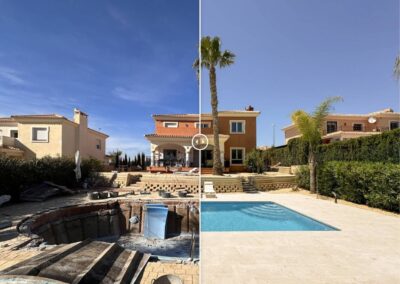
Don’t just take our word for it. Below, you can explore a gallery of our recent swimming pool renovation projects across the Alicante region. See exactly how we transform cheap plastic tubs into luxury, fully tiled concrete assets.


Contact
- Email: office@edenpool.net
- Address: C/ RESSOL 7 | BONALBA GOLF | MUCHAMIEL | ALICANTE | SPAIN
Program
MON-FRI 08:00 – 18:00
SAT-SUN closed – cerrado
